Criminal Responsibility of Officials for Establishment and Participation in Criminal Organizations
Keywords:
criminal organization, official, classification of crimes, power abuse, aggregate of crimes
Abstract
Article presents current issues of officials’ activities classification in terms of power abuse resulting in establishment and participation in criminal organisations. It is identified that power abuse must be interpreted as use of: official position by public authority; official status of duty position, enterprise, institution, state agency or organization; any types of official contacts. Use of official position is considered as abuse of power if it contradicts state or agency interests. Moreover – if official is committing a crime under Articles 255, 257, 2583, 260 of the Criminal Code of Ukraine, power abuse is performed for the benefit of criminal organisation. Officials may be involved in the process of its establishment, direct management or participate in its activities. This involvement includes use of official status and position; uniform and official markings; any types of IDs; weapon and non-lethal equipment; any type of official data. Nowadays official’s participation in criminal organisation’s activities is classified under Articles 255, 257, 2583, 260 of the Criminal Code of Ukraine (professional activity and public service). Under these conditions full scope of social danger posed by power abuse crimes is described in Articles 255, 257, 2583, 260 of the Criminal Code of Ukraine. Yet not all forms of power abuse in terms of criminal organisations establishment can be classified as crimes of professional activity and public service area. That is why we consider it necessary to amend the dispositions of Articles 364, 365 of the Criminal Code of Ukraine in order to cover all forms of power abuse stimulating the activities of criminal organisations.Downloads
Download data is not yet available.
Abstract views: 101 PDF Downloads: 88
How to Cite
[1]
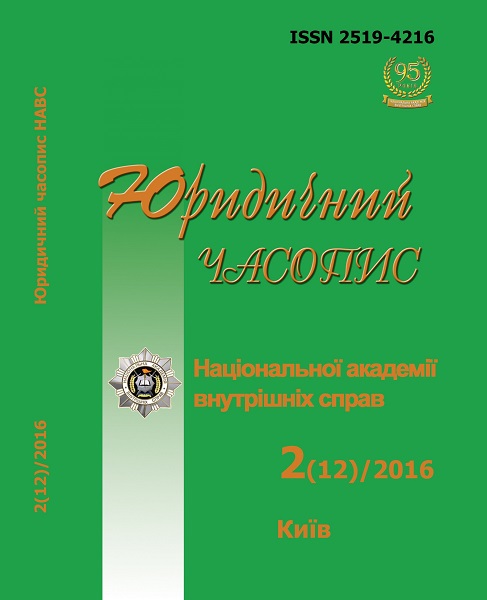
Vozniuk, A. 1. Criminal Responsibility of Officials for Establishment and Participation in Criminal Organizations. Law Magazine of the National Academy of Internal Affairs. 12, 2 (1), 78-92.
Issue
Section
Combating crimes: theory and practice
Copyright (c) 2017 Law Magazine of the National Academy of Internal Affairs

This work is licensed under a Creative Commons Attribution-NonCommercial-NoDerivatives 4.0 International License.
- Authors reserve the right to authorship of their own work and transfer to the magazine the right of the first publication of this work under the terms of the Creative Commons Attribution License, which allows other persons to freely distribute published work with mandatory reference to authors of the original work and the first publication of an article in this magazine.
- Authors have the right to enter into separate additional agreements on non-exclusive dissemination of the work in the form in which it was published in the journal (for example, to post an article in the institution's repository or to publish as part of a monograph), provided that the link to the first publication of the work in this journal is maintained.
- The journal's policy allows and encourages the posting of articles by authors on the Internet (for example, in electronic storehouses of institutions or on personal websites), both before the submission of this manuscript to the editorial office and during its editorial processing, as this contributes to the creation of a productive scientific discussion and positively affects the efficiency and dynamics of citing the published work.