Procedural Principles and Guarantees of Damage Reimbursed by Investigators as a Result of Criminal Offence
Keywords:
damage, criminal offence, reimbursement, investigator, suspect, presumption, principle, guarantee
Abstract
This article provides comprehensive analysis of interrelation between procedural guarantees, principles and presumptions in the aspect of damage reimbursed to the victim of criminal offence by investigator. Interrelation with the institute of damage reimbursement is studied. Current insufficiencies in legislative regulation are detected along with possible solutions. In the course of criminal offence committal person is subjected to psychological, material and physical damage and reimbursement process is totally in the scope of state’s responsibility. Guarantees, principles and presumptions are used as triggers to launch the reimbursement mechanism – investigator’s task is to prove the type and amount of damage. Other participants of the process are granted with more limited opportunities speaking of psychological, material and physical damage. Their role is mostly characterized as passive but extension of adversariality principle in current Criminal Procedure Code provides extra background for their active participation. Guarantees, principles and presumptions play an important role in effective restoration of violated rights and full reimbursement of the damage. It is identified that guarantees, principles and presumptions comprise a system aimed to ensure protection of rights and freedoms of all the participants of criminal proceeding including the damage reimbursement. These measures allow to restore the violated rights. But legislative regulation of the abovementioned issues is not deemed as satisfactory – some of them are rather controversial and require thorough research.Downloads
Download data is not yet available.
Abstract views: 91 PDF Downloads: 285
How to Cite
[1]
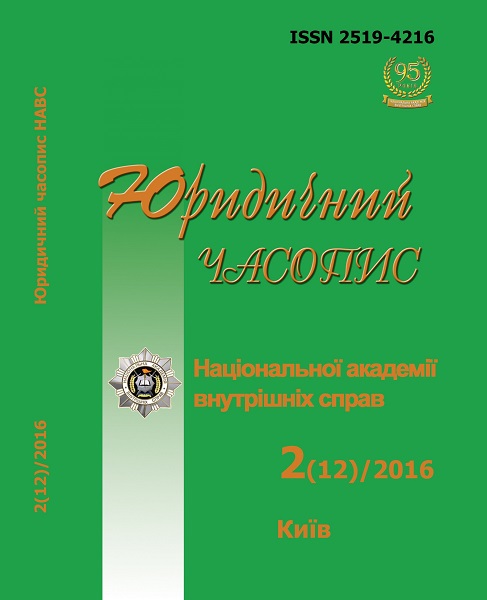
Sofin, M. 1. Procedural Principles and Guarantees of Damage Reimbursed by Investigators as a Result of Criminal Offence. Law Magazine of the National Academy of Internal Affairs. 12, 2 (1), 40-49.
Issue
Section
Law enforcement activities
Copyright (c) 2017 Law Magazine of the National Academy of Internal Affairs

This work is licensed under a Creative Commons Attribution-NonCommercial-NoDerivatives 4.0 International License.
- Authors reserve the right to authorship of their own work and transfer to the magazine the right of the first publication of this work under the terms of the Creative Commons Attribution License, which allows other persons to freely distribute published work with mandatory reference to authors of the original work and the first publication of an article in this magazine.
- Authors have the right to enter into separate additional agreements on non-exclusive dissemination of the work in the form in which it was published in the journal (for example, to post an article in the institution's repository or to publish as part of a monograph), provided that the link to the first publication of the work in this journal is maintained.
- The journal's policy allows and encourages the posting of articles by authors on the Internet (for example, in electronic storehouses of institutions or on personal websites), both before the submission of this manuscript to the editorial office and during its editorial processing, as this contributes to the creation of a productive scientific discussion and positively affects the efficiency and dynamics of citing the published work.