Organized and Professional Crime in Ukraine: Interdependence and Interinfluence
Keywords:
professional crime, organized crime, criminal professionalism, corruption, criminal business
Abstract
Professional crime is a comparatively independent type of crime which includes an array of crimes committed by criminal professional to gain the main or additional source of income, needs respective knowledge and skills, criminal expertise to achieve criminal goals. Specialization, qualification, committing crimes as a source of income, incorporation and cooperation, good knowledge and respect of criminal world’s customs and traditions are features of modern criminal professionalism. Decisive criterion of professional crime separation from organized crime is presence or absence of corruptive links. Namely their presence at professional crime means its transformation into organized crime. Holders of personal professional criminal skills and knowledge are one of the reserves of organized crime. From group professional criminal activity stage they are disgorged into organized crime structures, frequently becoming their organizers and leaders. Criminal who is incorporated into organized crime structure has features and peculiarities of professional – respective skills, expertise necessary to commit systematically certain crimes, an original technology of criminal activity. Professionalism and organized nature are interrelated; so long as criminal professionalism is higher, so well its organized forms appeared better. Due to relevant social conditions professional crime begins to transform into organized crime as qualitative new phenomenon. In modern Ukraine these most dangerous forms of crime’s deepening of connection is taking place, and they nourish and reproduce each other.Downloads
Download data is not yet available.
Abstract views: 143 PDF Downloads: 180
How to Cite
[1]
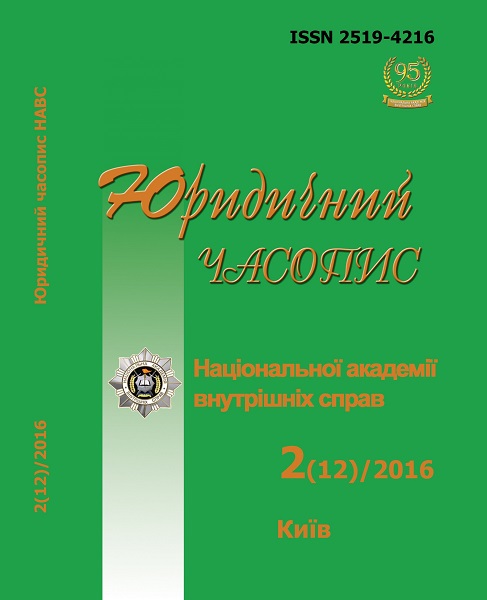
МаkarenkoN. 1. Organized and Professional Crime in Ukraine: Interdependence and Interinfluence. Law Magazine of the National Academy of Internal Affairs. 12, 2 (1), 94-100.
Issue
Section
Combating crimes: theory and practice
Copyright (c) 2017 Law Magazine of the National Academy of Internal Affairs

This work is licensed under a Creative Commons Attribution-NonCommercial-NoDerivatives 4.0 International License.
- Authors reserve the right to authorship of their own work and transfer to the magazine the right of the first publication of this work under the terms of the Creative Commons Attribution License, which allows other persons to freely distribute published work with mandatory reference to authors of the original work and the first publication of an article in this magazine.
- Authors have the right to enter into separate additional agreements on non-exclusive dissemination of the work in the form in which it was published in the journal (for example, to post an article in the institution's repository or to publish as part of a monograph), provided that the link to the first publication of the work in this journal is maintained.
- The journal's policy allows and encourages the posting of articles by authors on the Internet (for example, in electronic storehouses of institutions or on personal websites), both before the submission of this manuscript to the editorial office and during its editorial processing, as this contributes to the creation of a productive scientific discussion and positively affects the efficiency and dynamics of citing the published work.